
The choice between these flange types changes the weld geometry, inspection route, stress pattern, and long-term suitability of a process line. By comparing construction, service conditions, installation effort, and procurement documents, you can select the connection that fits the pipe rather than relying on pressure class alone.
Key takeaways
- Choose weld neck flanges for severe pressure, temperature, vibration, or thermal cycling.
- Use socket weld flanges on smaller-bore, lower-stress piping with accessible external welding.
- Specify pipe schedule, material grade, facing, pressure class, bore, and inspection documents.
- Compare socket weld flange suppliers in Pune by traceability, testing, and dimensional control.
How do socket weld and weld neck flanges join to the pipe?
A socket weld flange receives the pipe into a machined socket and joins it with an external fillet weld. A weld neck flange joins to a prepared pipe end through a full-penetration butt weld in its tapered neck.
| Option | Joint construction | Fit-up and inspection |
|---|---|---|
| Socket weld flange | Insert the pipe into the socket, leaving a controlled expansion gap at the socket bottom; the common value is about 1/16 inch (1.5 mm), unless the qualified welding procedure or project specification sets another value. | Do not force the pipe against the shoulder. Confirm insertion depth, gap, alignment, fillet size, welding access, and the internal socket geometry. |
| Weld neck flange | Prepare the pipe end for a butt weld through the tapered neck. Match the pipe outside diameter, wall thickness, or schedule to the flange bore. | Control bevel preparation, root gap, alignment, and weld penetration so the finished joint has no internal step. Inspection follows butt-weld requirements. |
This socket weld flange comparison involves more than flange shape. Socket welding changes access, internal flow geometry, and examination of the concealed shoulder and fillet; weld-neck construction changes pipe-end preparation and alignment.
ASME B16.5 covers flange dimensions, ratings, materials, testing, marking, and designations. ASME B16.25 addresses butt-welding-end preparation. Neither standard alone establishes service suitability; ASME B31.3, ASME B31.1, IBR requirements, or another governing specification must control that decision.
Which flange handles pressure, temperature, vibration, and thermal cycling better?
For pressure, temperature, vibration, and thermal cycling, a weld neck flange is usually the safer choice when loads are repeated or severe; ASME B16.5 pressure class alone does not decide it.
| Option | Pressure, temperature and fatigue behaviour | Service fit |
|---|---|---|
| Socket weld flange | The socket shoulder, internal fillet region and socket cavity create a local stress concentration and possible crevice. Thermal expansion, vibration, pressure cycling, erosion and fatigue magnify the risk. | Relatively clean, small-bore, non-cyclic service where the crevice and internal profile are acceptable |
| Weld neck flange | The tapered hub provides a more gradual load transfer and better internal bore continuity. It reduces the abrupt transition at the socket shoulder, but correct design and welding remain essential. | High-cycle, high-temperature, severe-service, toxic, corrosive, erosive, vacuum or highly stressed piping |
In a socket weld flange comparison, check the flange material grade, pipe wall thickness, temperature, gasket, bolting, corrosion allowance and qualified weld procedure alongside the ASME B16.5 class. A thicker wall or higher class does not remove a crevice, correct a poor weld profile, or prevent thermal-fatigue damage.
Choose the weld neck construction when dead-leg control, internal cleanliness, gradual stress transfer or fatigue resistance matters. Choose the socket arrangement only after confirming that its internal geometry suits the fluid and loading.
ASME B31.3, ASME B31.1, IBR requirements, or another named design basis controls the final decision. ASME B16.5 supplies flange ratings and dimensions; it does not approve the connection for every process service.
When is a socket weld flange a practical choice, and when is it the wrong alternative?
A socket weld flange is a weld neck flange alternative only when the service, geometry, and fabrication method support the substitution. Nominal size and pressure class do not prove interchangeability.
Socket weld flange applications are strongest on small-bore process connections, compact layouts, and locations where avoiding pipe-end beveling and internal butt-weld alignment reduces installation effort. Limited access can favour the socket arrangement if the welder can complete and inspect the external fillet, and the service accepts its internal shoulder and potential dead leg.
Approve a substitution only after checking:
- Compare the piping isometric, face-to-face dimensions, flange bore, hub length, overall projection, and required installation clearance.
- Confirm the replacement pipe-end preparation, internal bore, alignment method, support loads, and welding access.
- Verify the governing design basis, such as ASME B31.3, ASME B31.1, IBR requirements, or the project specification.
- Confirm that internal cleanliness, dead-leg control, inspection access, and repair provisions remain acceptable.
Choose a weld neck flange for lines subject to frequent maintenance disturbances, repeated thermal movement, high vibration, internal cleanliness demands, or fatigue-sensitive loads. Its butt-welded, tapered-hub arrangement is not a drop-in replacement; it requires different fit-up and inspection.
The apparent socket cost saving can disappear when beveling, access, repair, or service-life risk enters the decision. Conversely, its lower installation effort is valuable only when the socket crevice and internal profile do not threaten reliability.
How do fabrication, inspection, and field repair differ?
A socket-weld flange requires controlled fit-up before welding. Insert the pipe without forcing it against the socket shoulder, maintain the specified expansion gap—commonly about 1/16 inch (1.5 mm)—and verify alignment, fillet size, weld sequence, and access to the internal socket region.
The shoulder and internal fillet cannot be examined like an open butt joint, so visual examination and, where specified, magnetic-particle or liquid-penetrant testing commonly control surface quality.
| Option | Fabrication and inspection workload | Field-repair implications |
|---|---|---|
| Socket-weld flange | Check insertion, socket gap, alignment, fillet dimensions, sequence, and internal access; radiography does not automatically replace specified fillet-weld controls. | Repair access is restricted around the socket and internal shoulder; assess clearance, heat treatment, and repeat welding before installation. |
| Weld-neck flange | Prepare the bevel to ASME B16.25 or the project drawing, control root gap and alignment, complete the qualified full-penetration butt-weld procedure, and apply the purchase specification’s NDE extent. | Radiography suits volumetric examination of the butt weld; repair and inspection access are usually more direct, but field beveling and clearance take more time. |
Apply ASME Section IX to welding-procedure and welder qualification when it forms part of the code basis. Confirm the required visual, surface, radiographic, or other examination before fabrication; do not select the apparently faster socket option until field clearance, repair welding, heat treatment, and inspection access are checked.
ASME B31.3 governs process-piping design and fabrication when it applies.
What should you specify when buying either flange in Pune?
“ASME flange” is not a purchase specification. For a socket weld flange vs weld neck flange in Pune, control the item against the project requirement and compare suppliers on evidence, not catalogue labels.
| Option | Specify the connection | Confirm before release |
|---|---|---|
| Socket weld flange | ASME B16.5 edition, NPS, pressure class, facing, material grade, socket bore, service temperature and governing code | Socket dimensions, tolerances, pipe fit, fillet-weld requirements and access |
| Weld neck flange | The same details, plus actual pipe outside diameter and wall thickness or schedule | Bore compatibility, hub dimensions, ASME B16.25 end preparation and internal alignment |
Include these purchase-order and inspection requirements:
- State the quantity, dimensional tolerances, flange type, gasket facing and applicable code, such as ASME B31.3 or ASME B31.1.
- Request the material test certificate, heat number, heat traceability, material grade and forging or plate route.
- Require a dimensional report covering bore, face, bolt circle, thickness, hub and marking details.
- Request welding procedure, welder qualification and NDE records where the specification requires them.
- Demand packaging that protects the raised face or ring-groove face from impact, moisture and contamination.
For IBR-governed steam or boiler work, verify the IBR inspection route, approved manufacturer or inspector requirements, material documents and whether the component falls within IBR scope. ASME B16.5 compliance alone is not IBR approval.
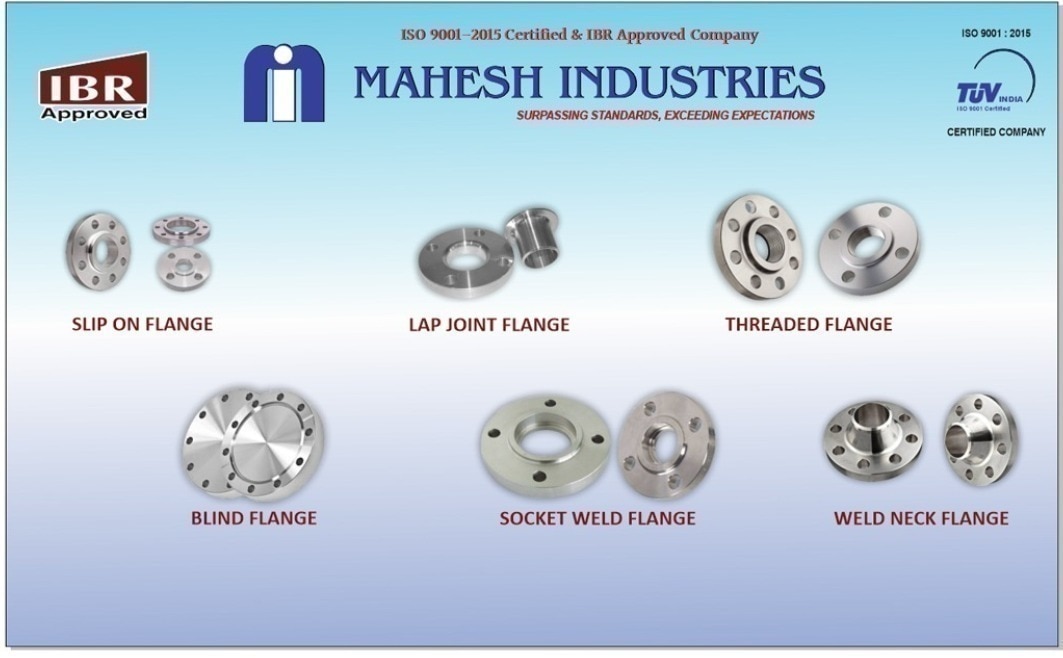
An industrial flange supplier in Pune such as Mahesh Industries should be evaluated against this complete document-and-dimension checklist.
Related products
 | Weld Neck Flanges Mahesh Industries, based in Navi Mumbai, is a reputed manufacturer and supplier of high-quality weld neck flanges. View product → |
 | Socket-Weld-Flanges Mahesh Industries is a leading manufacturer and supplier of high-quality socket weld flanges, known for their precision engineering and durability. View product → |
Frequently asked questions
How do socket weld and weld neck flanges join to the pipe?
A socket weld flange receives the pipe into a machined socket and uses an external fillet weld. A weld neck flange joins to a prepared pipe end through a full-penetration butt weld in its tapered neck.
Which flange handles pressure, temperature, vibration, and thermal cycling better?
A weld neck flange is the stronger choice for severe pressure, temperature, vibration, and repeated thermal cycling because its tapered neck supports a full-penetration butt weld and smoother stress transfer.
When is a socket weld flange a practical choice, and when is it the wrong alternative?
Choose a socket weld flange for smaller-bore piping where access and fabrication simplicity matter. Avoid it when cyclic loading, severe thermal gradients, high stress, or demanding internal cleanliness makes the socket detail unsuitable.
How do fabrication, inspection, and field repair differ?
Socket welds require controlled pipe insertion, a specified internal gap, and fillet-weld inspection. Weld necks require bevel preparation, alignment, full-penetration welding, and volumetric inspection when specified; field repair usually demands more preparation.
What should you specify when buying either flange in Pune?
State the standard, material grade, pressure class, nominal size, pipe schedule or bore, facing, dimensions, heat number traceability, inspection requirements, and required certificates before requesting a quotation from an industrial flange supplier in Pune.