
A reducing flange must match two pipe sizes, the mating flange, the service conditions, and the project’s inspection requirements. By the end, you will be able to define the correct specification, compare a reducing-flange quote, verify supplier documents, and decide when a separate reducer is the safer choice.
Key takeaways
- Use a reducing flange at compact equipment nozzles and short flanged connections.
- Confirm standard, nominal sizes, pressure class, face type and drilling before ordering.
- Match flange material and temperature rating to the pipe service and joining method.
- Compare quotes by dimensions, documents, inspection, lead time and delivered cost.
Choose the right reduction for the piping layout
Use a reducing flange when the size change belongs directly at an equipment nozzle or compact flanged connection. It joins the larger pipe to the smaller pipe at the flange itself, saving the weld, spool length and second flange required by a separate reducer assembly.
| Option | Arrangement | Choose it when | Trade-off |
|---|---|---|---|
| Reducing flange | One flange has a larger outside connection and smaller bore | Space is limited and the nozzle layout needs a direct size transition | Less flexibility for length, offset and later inspection |
| Reducer plus two standard flanges | A concentric or eccentric reducer sits between two ordinary flanges | You need a defined face-to-face length, an eccentric offset, accessible welds or easier replacement | More components, welds, bolts and leakage paths |
Follow the piping isometric and the equipment nozzle face-to-face dimension, not the nominal pipe sizes alone. A reducing flange suits a straight, concentric transition; it is a poor choice where a horizontal pump suction needs an eccentric reducer to prevent an air pocket, or where drainage requires the pipe to remain flush at the bottom.
Before ordering steel reducing flanges, confirm that the smaller bore matches the pipe schedule and that the flange drilling matches its mating flange. A compact connection is useful only when it fits the layout and can still be welded, inspected and maintained.
Build the specification from standards, sizes and drilling
Before a reducing flange manufacturer prices the item, state the large-end nominal pipe size, reduced bore or small-end size, flange type, facing, pressure rating, material grade, schedule, and drilling standard. Also provide the pipe’s actual outside diameter and wall thickness: nominal size alone cannot prevent a weld mismatch, counterbore error, or internal step.
Include these details in the request:
- ASME Class or EN PN rating
- Raised face, flat face, ring-type joint, and specified face finish
- Bolt-hole quantity, diameter, pitch-circle diameter, and hole orientation
- Forged or plate-built construction, material standard and grade, heat number requirement
- IBR or non-IBR status, inspection level, certificates and quantity
- Approved drawing requirement if the standard does not define the reducing configuration
Use the mating flange or piping-class requirement to settle the drilling system. ASME B16.5 covers NPS ½ through 24; ASME B16.47 covers larger sizes and offers Series A or Series B drilling, which are not interchangeable. EN 1092-1 uses PN designations and different dimensions, bolt patterns and facings.
| Standard | What to state | Critical check |
|---|---|---|
| ASME B16.5 | NPS, Class and drilling | Mating flange pattern |
| ASME B16.47 | NPS, Class and Series A or B | Series compatibility |
| EN 1092-1 | DN, PN and facing | Do not mix with ASME dimensions |
Match material, pressure class, face and service temperature
Select steel reducing flanges by fluid compatibility and design temperature, then verify pressure capacity at that temperature—not from “Class 300” alone. For stainless or alloy service, specify ASTM A182/A182M and the exact grade, such as F304L or F316L. “SS” leaves corrosion resistance and weldability unresolved.
Confirm the grade’s allowable stress against the project design pressure and temperature.
State the large-end nominal pipe size, reduced bore or small-end size, schedule or wall-thickness basis, drilling standard and pressure class. Above the ASME B16.5 size range, obtain the mating drilling: ASME B16.47 Series A and Series B are not interchangeable.
Do not substitute EN 1092-1 PN dimensions for ASME dimensions; bolt circles, holes and facing details differ.
Match the flange face to the mating flange and gasket. Raised face, flat face and ring-type joint require compatible gasket designs and compression limits. Specify gasket material for the fluid and temperature, then select bolts for flange material, operating temperature, corrosion exposure and required preload.
A wrong gasket or bolt set can leak even when the bore and drilling fit. Have the supplier confirm flange, gasket and fastener compatibility in the approved drawing.
Verify fit, welding and documentation before installation
Check the approved drawing against the pipe spool before releasing the flange for fit-up. Confirm the large-end nominal size, actual pipe outside diameter, wall thickness or schedule, reduced bore, transition geometry, face, pressure class, material grade, drilling standard and bolt-hole orientation. A nominal NPS match alone will not prevent an internal step or weld mismatch.
1. Ask whether the flange is forged in one piece, machined from a forging, fabricated from plate or welded from components. If welds or fabrication are present, require the qualified WPS and PQR, welder qualification, specified weld inspection, NDE and any required post-weld heat treatment.
2. Require a heat-wise EN 10204 3.1 certificate showing the heat number, chemical analysis and tensile results. Add the dimensional report, heat-treatment record and PMI for stainless or alloy steel. For ASTM A182/A182M material, check the exact grade, such as F304L or F316L, rather than accepting “stainless steel.”
3. For IBR service, match the certificate and inspection documents to the actual heat and item, then confirm acceptance against the applicable Indian Boiler Regulations requirement and project inspection plan. An “IBR-approved” description alone proves nothing.
On arrival, compare markings and heat number with the certificates, then measure the bore, weld-end thickness, face, outside diameter, bolt circle and hole pattern. Reject or quarantine the flange if the bevel, counterbore, face, bore or documentation differs from the approved drawing.
Compare a Mumbai supplier quote on technical and commercial terms
Send every reducing flange supplier in Mumbai the same enquiry schedule; otherwise a low price may simply omit machining, inspection or freight. State:
- Large and small nominal sizes, bore or pipe schedule, flange type, facing and finish
- ASME B16.5 class and drilling, or EN 1092-1 PN designation; for sizes above NPS 24, specify ASME B16.47 Series A or Series B
- Material grade, quantity, IBR or non-IBR status, inspection level and required certificates
- Bolt-hole details, delivery point, GST and freight basis, payment terms and quote validity
For stainless steel, name the grade, such as ASTM A182/A182M F316L, rather than writing “SS.” Ask Mahesh Industries to price the identical schedule, so its offer can be compared fairly with another Navi Mumbai supplier.
| Quote item | Compare | Clarify before accepting |
|---|---|---|
| Technical | Size, class, face, bore, drilling and grade | Missing dimensions or “ANSI” wording |
| Quality | IBR status, inspection, MTC and certificates | Certificate type and issuing stage |
| Commercial | Unit price, GST, freight, lead time and validity | Exclusions, delivery date and packing |
| Compatibility | Mating standard and B16.47 series | Never assume ASME and EN/DIN interchangeability |
Related product
 | Reducing Flanges Mahesh Industries, based in Rabale, Navi Mumbai, is a reputable manufacturer of high-quality reducing flanges used in various industrial piping... View product → |
Know when a reducing flange is the wrong connection
A reducing flange is the wrong choice when the piping needs a controlled flow transition, a specific reducer length, or better weld access. Check the isometric and equipment-nozzle face-to-face dimension before you buy reducing flanges in Mumbai.
| Option | Choose it when | Why it may be better |
|---|---|---|
| Concentric reducer | The pipe is vertical, or horizontal flow will not trap air or drain liquid | It provides a centred, gradual size change between two ordinary flanges |
| Eccentric reducer | A pump suction line, horizontal drain, or process line must avoid vapour or liquid pockets | Orient the flat side to suit the service: flat-side-up commonly prevents air pockets at pump suction; flat-side-down supports drainage |
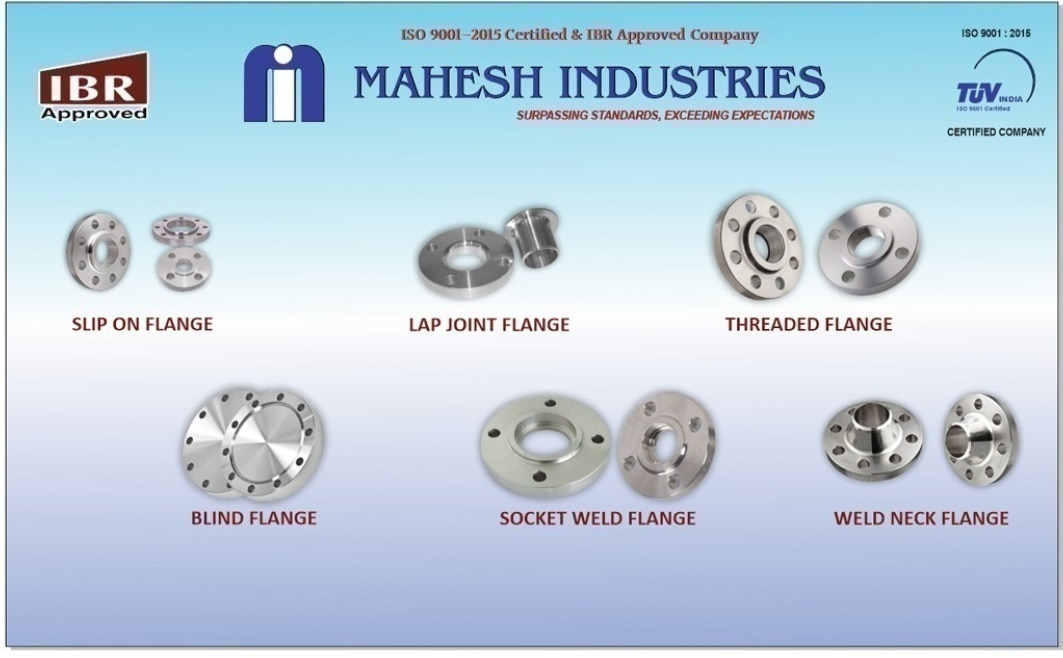
| Weld-neck flange | The joint faces high pressure, temperature, cyclic loading, or demanding weld inspection | Its butt-weld connection transfers stress more smoothly than a slip-on flange |
| Slip-on flange | The service is moderate and installation cost or field fit-up matters more than maximum fatigue resistance | It is easier to align, but its fillet weld and shorter bore provide less robust stress performance |
| Separate reducer and two standard flanges | You need a defined reducer length, internal inspection access, replaceable flanges, or a nozzle dimension that a reducing flange cannot match | The assembly costs more joints and welding, but gives greater layout and maintenance control |
Never substitute an ASME reducing flange for an EN 1092-1 arrangement without checking drilling and facing; the standards are not interchangeable.
Frequently asked questions
When should you use a reducing flange instead of a separate reducer?
Use a reducing flange when the size change belongs at an equipment nozzle or compact flanged connection. A separate reducer is better when you need a longer transition, welded spool or easier field replacement.
What details belong in a reducing flange specification?
State the standard, large and small nominal pipe sizes, flange type, outside diameter, thickness, bore, bolt-hole count, bolt-circle diameter, hole diameter and facing.
How do you match a reducing flange to service conditions?
Match the material, pressure class, face and temperature rating to the pipe system, fluid, design pressure, design temperature, corrosion conditions and joining method.
What should you verify before installing a reducing flange?
Check the dimensions against the mating flange, confirm bore and bolt alignment, inspect the face and weld preparation, and collect material certificates, inspection records and applicable approvals.