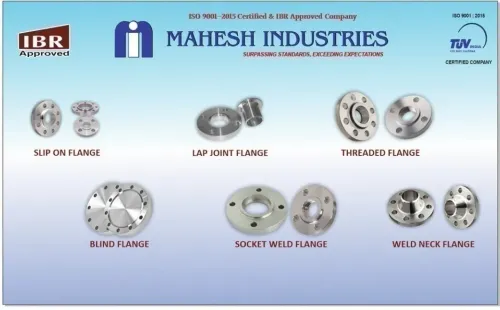

The choice between ASME B16.47 and ASME B16.5 begins with nominal pipe size, not with a claim that one flange is universally stronger. By comparing size limits, pressure classes, Series A and Series B dimensions, and ordering checks, you can select a compatible flange set and avoid a costly mismatch in a Navi Mumbai procurement.
Key takeaways
- Use ASME B16.5 for NPS 1/2–24 and B16.47 for NPS 26–60.
- Treat NPS 25 as outside both standards, not as an automatic bridge.
- Check series, facing, bolt pattern, bore, pressure class, and material before ordering.
- Request drawings, mill certificates, and dimensional inspection records from your supplier.
Where ASME B16.47 Ends and ASME B16.5 Begins
ASME B16.5 governs NPS 1/2 through NPS 24; ASME B16.47 governs NPS 26 through NPS 60. NPS 25 falls outside both size ranges, so do not treat it as an automatic bridge between the standards.
| Standard | Nominal pipe sizes | Pressure classes | Typical applications |
|---|---|---|---|
| ASME B16.5 | NPS 1/2–24 | 150, 300, 400, 600, 900, 1500, 2500 | General process piping, plant utilities, equipment nozzles, and compact flanged connections |
| ASME B16.47 | NPS 26–60 | 75, 150, 300, 400, 600, 900 | Large-diameter process lines, storage terminals, power systems, pipelines, and vessel nozzles |
B16.47 is not a larger-size version of every B16.5 flange. It is the governing reference for large-diameter steel flanges, with Series A or Series B selected according to the project specification and edition.
Its common applications centre on weld-neck and blind flanges, while B16.5 covers a wider selection, including slip-on, threaded, socket-weld, lap-joint, reducing, weld-neck, and blind types.
The search phrase “ansi b16 point 47 vs asme b16 point 5 flanges” uses informal terminology. Technically, an asme b16 point 5 flange comparison means checking the standard designation, NPS, pressure class, series, facing, bore, flange type, and material—not merely matching the nominal diameter.
A B16.5 flange cannot replace a B16.47 flange at NPS 26 or above.
Series A and Series B: The Dimensional Trade-Off
Series A and Series B can produce different flanges for the same NPS and pressure class. They are not interchangeable: bolt-circle diameter, outside diameter, bolt count, bolt size and flange thickness may all change.
| Dimension or impact | Series A | Series B |
|---|---|---|
| Bolt arrangement | Larger bolt-circle pattern with larger, fewer or differently specified bolts depending on size and class | More compact bolt-circle pattern with smaller, more numerous bolts in many size and class combinations |
| Flange size and weight | Generally larger and heavier | Generally smaller and lighter |
| Installation effect | Needs more lifting capacity, storage space, bolt-clearance area and handling effort | Simplifies handling and reduces space around the joint |
| Connection risk | Will not mate with Series B unless every facing, drilling and dimensional detail matches | Will not mate with Series A merely because the NPS and class match |
The weight saving of Series B can reduce crane, rigging and manual-handling demands, but it does not make it a drop-in replacement. A different bolt pattern changes gasket selection, bolt length, tightening access and the position of connected pipe supports. Confirm the complete mating set before fabrication.
For procurement, write “ASME B16.47 Series A” or “ASME B16.47 Series B” on the drawing and purchase order. Do not write only “B16.47 flange.” The practical ansi b16 point 47 flange advantages depend on selecting the series that matches the existing equipment and piping layout.
For a buyer assessing ansi b16 47 flange benefits vs asme b16 5 in navi mumbai, the decisive comparison is the approved dimensional series, not the search label “ANSI flange.”
Pressure Classes Do Not Make Flanges Interchangeable
Compare Class 75 through Class 2500 by standard, nominal size, material, temperature, and dimensions—not by the class number alone. A class is a pressure-temperature designation, not a universal flange geometry. The rating also changes with the material group and operating temperature shown in the applicable ASME tables.
| Class | ASME B16.47 | ASME B16.5 | Comparison rule |
|---|---|---|---|
| Class 75 | Yes | No | Applies to large-diameter B16.47 flanges only |
| Class 150–900 | Yes | Yes | Same class number does not make dimensions interchangeable |
| Class 1500–2500 | No | Yes | Applies to B16.5, within its NPS range |
For an ASME B16.5 flange comparison, confirm the NPS before comparing ratings: B16.5 covers NPS 1/2 through NPS 24, while B16.47 covers NPS 26 through NPS 60. A Class 300 B16.47 flange and a Class 300 B16.5 flange can differ in bolt-circle diameter, outside diameter, bolt count, bolt size, and thickness.
The same warning applies to ANSI B16.47 vs ASME B16.5 flanges within overlapping class numbers. For B16.47, identify Series A or Series B because each series uses different dimensions. State the standard, edition, NPS, class, series, facing, bore, flange type, material, and rating basis on the purchase order.
Otherwise, the bolt holes may not align with the mating flange.
The Purchase-Specification Checks That Prevent a Mismatch
A purchase order that says only “B16.47 flange” can produce a matched-looking set with different bolt geometry. State the following details before requesting a quote, especially when comparing ansi b16 point 47 flange advantages or ansi b16 47 flange benefits vs asme b16 5 in navi mumbai.
- Standard and edition: ASME B16.47 or ASME B16.5, with the edition year.
- Size and rating: NPS, pressure class, and design temperature; do not treat Class 300 as a universal pressure value.
- Series: B16.47 Series A or Series B. Record the bolt-circle diameter, bolt count, bolt size, outside diameter and thickness from the selected table.
- Connection geometry: weld-neck, blind, slip-on or another specified type; facing, bore diameter or pipe schedule, raised-face height, and flange finish.
- Metallurgy: material specification, grade, supplementary requirements, heat treatment and impact-test requirements.
- Quality documents: heat number, material test certificate, dimensional report, examination method and acceptance criteria, plus coating or preservation requirements.
- Compliance: state IBR documentation, inspection authority, accepted manufacturing route and certificates when the equipment or service falls under IBR.
| Detail | B16.47 entry | B16.5 entry |
|---|---|---|
| Size range | NPS 26–60 | NPS 1/2–24 |
| Series | State A or B | No B16.47 series selection |
| Rating | Class 75–900, checked at temperature | Class 150–2500, checked at temperature |
A drawing must show the bolt pattern and bore, not just the nominal size. That prevents a supplier from quoting a dimensionally different flange that carries the same class marking.
Choosing a Navi Mumbai Supplier for the Complete Flange Set
A quote from an ansi flange supplier in navi mumbai is not technically complete until it identifies the exact standard, edition, size, and construction. Without those details, you could receive a flange with the wrong bolt circle, facing, bore, or permitted configuration.
| Check | Evidence to request | Reject if |
|---|---|---|
| Standard and dimensions | ASME B16.5 or B16.47, edition, NPS, pressure class, Series A or B, flange type, facing, bore or schedule | The quote says only “ANSI flange” |
| Material and manufacture | Material specification and grade, plate or forging route, heat-treatment record, coating details, and marking or heat traceability | The grade or manufacturing route is missing |
| Inspection | Dimensional report, examination results, test reports, and project-required third-party inspection certificate | Inspection is described without named records |
| IBR compliance | Applicable material certificates, heat records, approved inspection route, and documents accepted by the project’s IBR authority or inspector | The supplier treats IBR as a pressure class or supplies only EN 10204 3.1 |
For IBR-controlled service, confirm acceptance before production; a B16.47 marking does not prove IBR approval. Ask who will review the dossier and which forms that reviewer requires.
Mahesh Industries should be evaluated against this same document checklist, not selected solely because it supplies both B16.47 and B16.5 flanges. A complete flange set also needs matching dimensions, materials, markings, certificates, and inspection records across every component.
Related products
 | Ansi-B16.47-Flanges Mahesh Industries is a reputed manufacturer, supplier, and exporter of ANSI B16.47 flanges, designed for large-diameter piping systems used in... View product → |
 | Asme B16.5 Flanges Mahesh Industries is a trusted manufacturer, supplier, and exporter of ASME B16.5 flanges, designed to meet global standards for pressure and... View product → |
Frequently asked questions
Where does ASME B16.47 apply, and where does ASME B16.5 apply?
ASME B16.5 covers NPS 1/2 through NPS 24. ASME B16.47 covers NPS 26 through NPS 60. NPS 25 falls outside both standards.
What is the difference between ASME B16.47 Series A and Series B?
Series A and Series B use different dimensions, bolt patterns, flange outside diameters, and weights. Confirm the specified series before matching a flange to equipment or piping.
Does the same pressure class make B16.47 and B16.5 flanges interchangeable?
No. A shared pressure class does not guarantee matching dimensions, bolt-hole spacing, facing, bore, or pressure-temperature ratings. Match the complete standard designation and dimensions.
What should you include in a flange purchase specification?
State the standard, NPS, Series A or B where applicable, pressure class, flange type, facing, bore, material grade, schedule, bolting requirements, gasket type, and inspection documents.
How do you choose a Navi Mumbai flange supplier?
Choose a supplier that can provide the complete flange set, dimensional drawings, material test certificates, heat or batch traceability, inspection records, and clear confirmation of the required standard and series.